15 October, 2026
The Relationship Between Upward Displacement of the Hoof Capsule, Toe Length, and the Dorsal Hoof Wall Angle
Why does a hoof develop an increasingly longer toe and a lower dorsal wall angle?
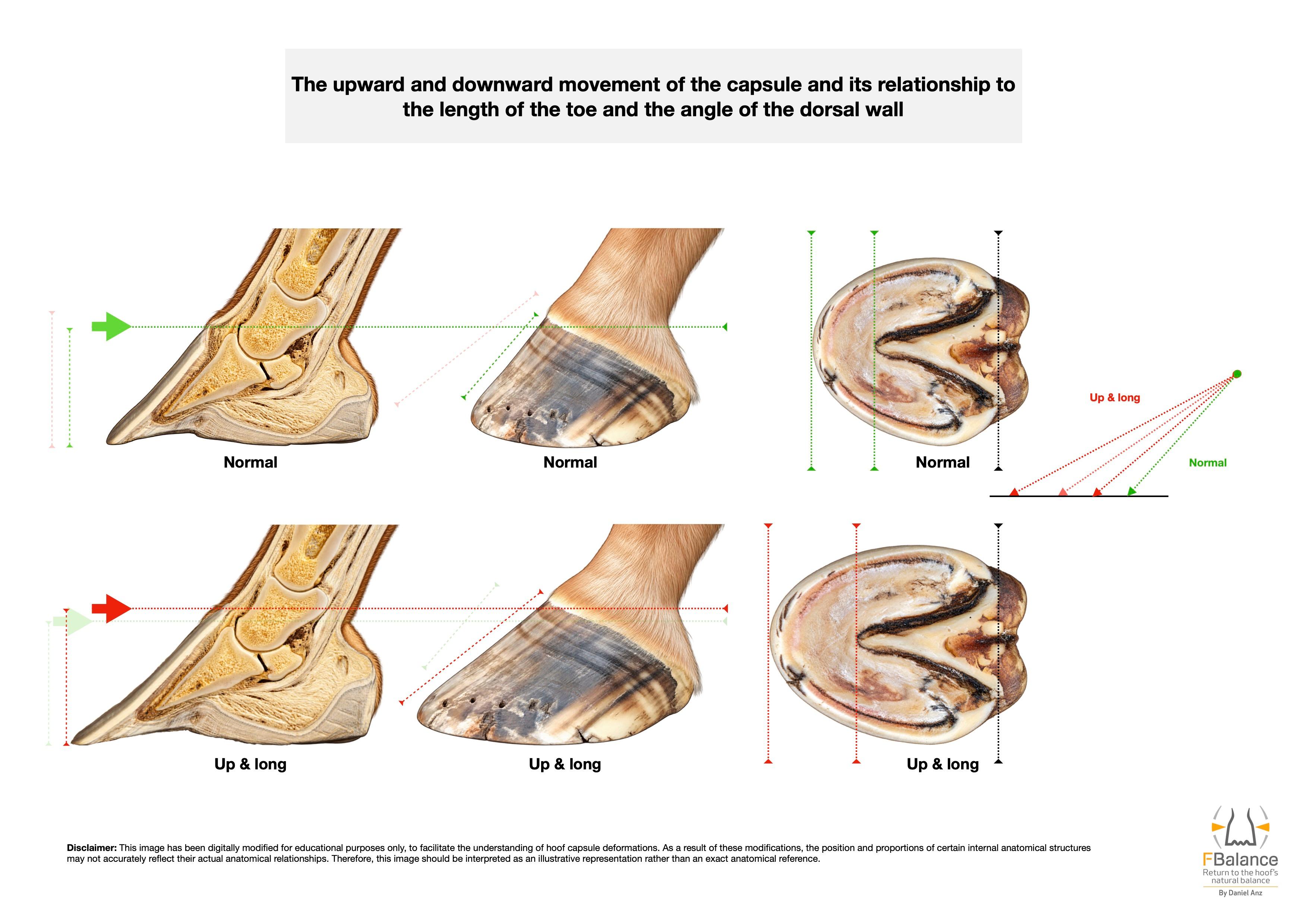
To understand this phenomenon, we must consider not only the growth of the hoof wall but also the position of the hoof capsule in relation to the internal structures of the foot.
The hoof capsule is attached to the internal structures through the laminar interface, or dermoepidermal junction. This connection maintains the relationship between the hoof wall and the internal structures while the wall continuously grows toward the ground.
However, when the hoof capsule undergoes progressive upward displacement, associated with mechanical forces acting from the distal edge of the wall and possible metabolic disorders that weaken this connection, its position and geometry begin to change.
What happens during this process?
As the hoof capsule moves upward relative to the internal structures of the foot while continuing to grow, the toe tends to become progressively longer.
This elongation is accompanied by a change in the inclination of the dorsal hoof wall, whose angle relative to the ground tends to decrease.
Therefore, there is a relationship between three factors:
- Upward displacement of the hoof capsule: the hoof wall changes its relative position in relation to the internal structures of the foot.
- Increased toe length: as growth continues, the dorsal region may extend progressively farther forward.
- Decreased dorsal wall angle: the wall gradually assumes a lower angle relative to the ground.
These changes are interconnected and may form part of a progressive process of hoof capsule deformation.
The importance of understanding the cause, not just the consequence
When we observe a hoof with an excessively long toe and a reduced dorsal wall angle, it is common to focus only on trimming away the excess length or even removing sole material in an attempt to "shorten the hoof."
However, according to the Balance F® concept, we must also consider the forces acting on the hoof capsule and the displacements — both upward and downward — that may occur when the dermoepidermal junction is not in a healthy condition.
The goal of trimming is not simply to shorten the toe, but also to properly manage the pressures and leverage forces acting on the hoof wall, seeking to promote a more appropriate functional relationship between the length of the hoof capsule and the internal structures.
This means understanding that toe length and the dorsal hoof wall angle should not be analyzed as isolated characteristics, but rather as part of a set of mechanical relationships that influence hoof shape.
A hoof capsule that moves upward while continuing to grow may develop a progressively longer toe and a lower dorsal hoof wall angle.
Understanding this relationship allows us to better interpret certain deformities and guide our trimming decisions toward their possible mechanical causes, rather than simply correcting their external manifestations by removing areas of the hoof that may be serving an important function.
It is important to remember that not all hooves with long toes or reduced dorsal wall angles necessarily share the same mechanism of deformation. Each foot must be evaluated individually.
Note: The images have been digitally modified for educational purposes to facilitate the understanding of hoof capsule deformities. As a result of these modifications, the position and proportions of certain internal anatomical structures may not accurately reflect their actual anatomical relationships. Therefore, the images should be interpreted as illustrative representations rather than exact anatomical references.