15 October, 2026
Ascent and Descent of the Hoof Wall
The hoof, or hoof capsule, protects the internal structures of the foot and maintains a dynamic relationship with them through the lamellar apparatus.
This dermo-epidermal junction should not be understood as a completely rigid structure: within certain physiological and pathological limits, the hoof capsule can change its position relative to the internal structures of the foot.
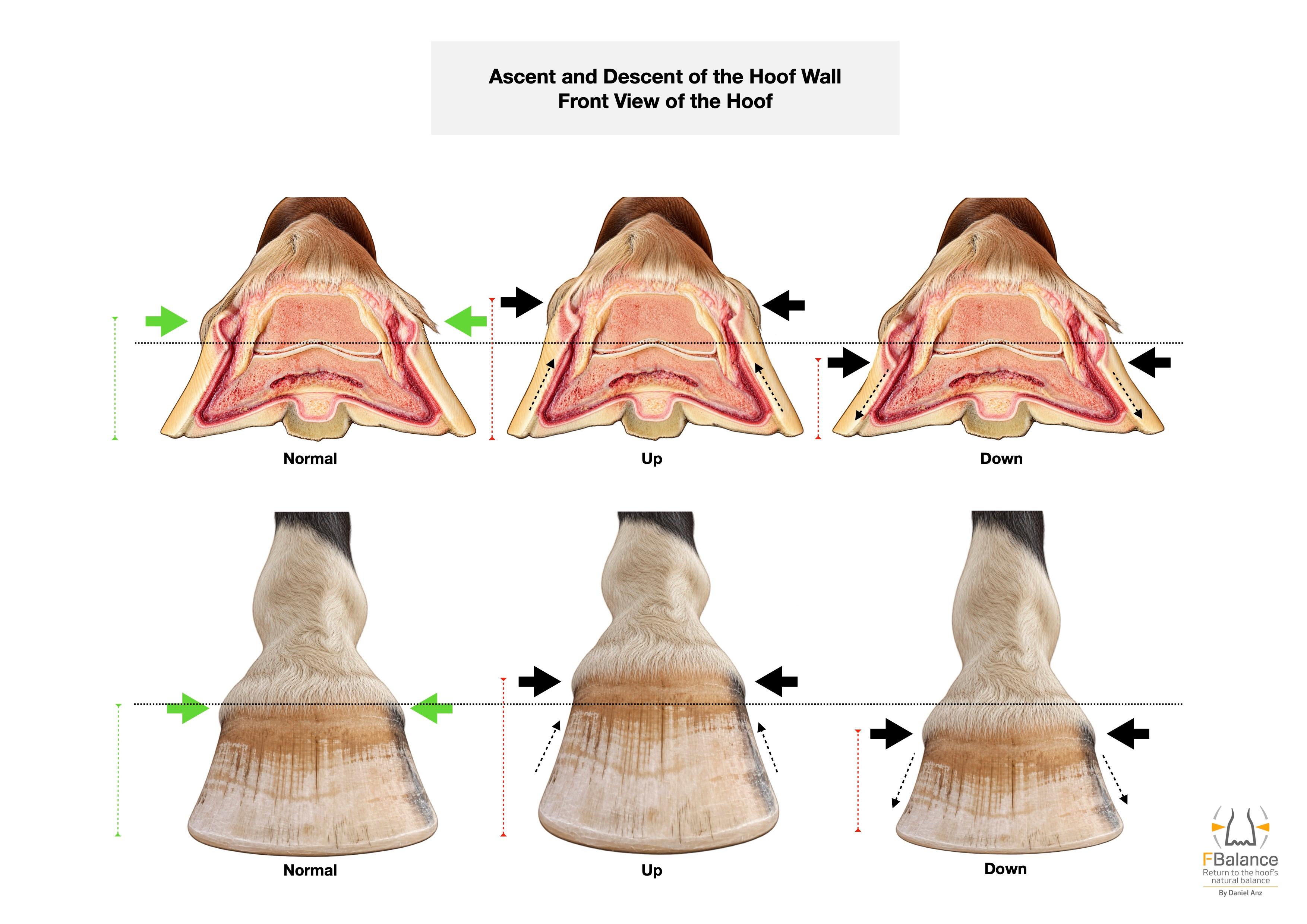
The speed at which these changes may occur depends, among other factors, on the functional condition of the lamellar apparatus. Based on my clinical experience, when the dermo-epidermal junction is healthy and functional, changes in the position of the hoof capsule tend to occur progressively over a period of days. When, on the other hand, the lamellar apparatus is weakened or compromised, certain changes may occur much more rapidly, sometimes within a matter of hours.
Approximately 16 years ago, I had an experience that profoundly changed the way I interpreted this phenomenon.
After removing the shoes from a horse and turning it out into the field, I observed that the front hooves gradually began to lose height as the distal border of the hoof wall broke away and was no longer able to provide sufficient support.
Within a few days, both hooves had become excessively short and showed a visible descent of the coronary bands. The horse showed bilateral pain in the forelimbs and considerable difficulty moving.
What had happened?
The hoof capsule had descended relative to the internal structures because the lamellar apparatus was not providing sufficient support. The sole, however, remained practically intact and maintained its relationship with the internal structures of the foot. What had clearly changed was the relative position of the hoof capsule.
From that experience onward, I began to understand that the relationship between the dermal and epidermal lamellae must be regarded as a biologically active and dynamic junction.
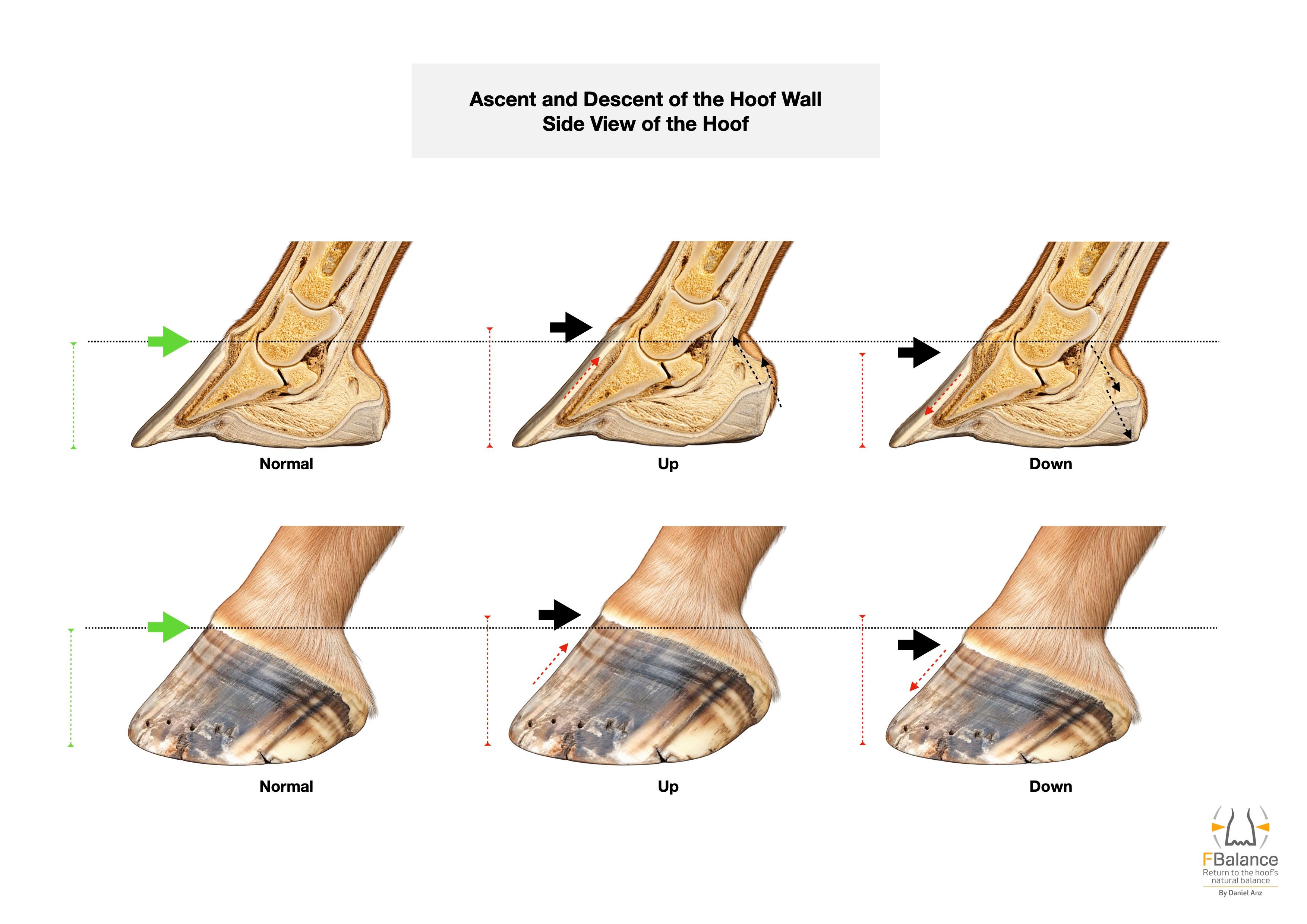
When the lamellar apparatus is healthy, it can allow certain adaptive and displacement processes while at the same time maintaining a mechanically stable connection. When this structure is compromised, its supporting capacity decreases and the relationship between the hoof capsule and the internal structures of the foot can change significantly.
An extreme example of loss of stability within the lamellar apparatus can be observed in certain cases of laminitis, in which the integrity of the dermo-epidermal junction becomes compromised and displacement of the hoof capsule or of the internal structures of the foot may occur.
From that point on, I began to use this concept as a tool for interpreting and correcting certain hoof deformities.
If we accept that the hoof capsule can change its relative position through processes of ascent and descent, it becomes easier to understand that many deformities do not necessarily need to be corrected by altering the position of the sole.
This concept has a very important practical consequence:
during trimming, it is not always necessary to remove or weaken the sole in order to modify the external orientation of the hoof.
As a hoof trimmer, I can work on the distribution of pressures along the distal border of the hoof wall, allowing the hoof capsule to progressively reorganize its position around the internal structures of the foot, while at the same time preserving the thickness and protective function of the sole.
One of the mistakes that, in my opinion, is frequently made during trimming — both in barefoot horses and in shod horses — is to disregard certain natural limits of the foot and excessively reduce sole thickness in an attempt to artificially change the position of the hoof relative to the limb or to achieve a particular external alignment.
When structures that the foot requires for load bearing are removed, imbalances may develop that the horse will attempt to compensate for through postural changes and adaptations within the musculoskeletal and myofascial systems.
For this reason, I consider it essential to learn how to correctly manage the pressures acting on the border of the hoof wall.
Appropriate release and redistribution of these pressures can help the hoof capsule progressively recover a more functional shape and position, making use of the adaptive capacity of the lamellar apparatus without unnecessarily weakening the sole.
Understanding this relationship between pressure, the lamellar apparatus, the hoof wall, the sole, and the position of the hoof capsule can profoundly change the way hoof trimming is interpreted.
This concept and its practical applications are explored in greater depth in the theoretical online course offered by our school.
Note: The images have been digitally modified for educational purposes to facilitate the understanding of hoof capsule deformities. As a result of these modifications, the position and proportions of certain internal anatomical structures may not accurately reflect their actual anatomical relationships. Therefore, the images should be interpreted as illustrative representations rather than exact anatomical references.